17. International Conference Crisis Management Days, Terme Tuhelj, Croatia

With increasingly pronounced ecological disasters, political tensions and technological threats, dealing with crisis situations is becoming more and more complex. In this turbulent time, solutions are brought by the 17th edition of the scientific and professional conference Days of Crisis Management, which was held on Wednesday, May 22 and Thursday, May 23 in Terme Tuhelj, organized by the Velika Gorica Polytechnic. This important event brought together leading experts in the field of crisis management who will discuss and present the latest research and solutions on hot topics such as climate change, sustainability, security and protection, international and European security, communication and technology, and analysis of crisis situations.
The world is facing climate change that affects us more and more. Extreme weather conditions, floods, fires and hurricanes are becoming more frequent, leaving behind destruction and human tragedies. The sustainability of our planet is no longer just a matter of choice, but a necessity that we must urgently address. The conference highlighted how to integrate sustainable practices into all segments of society and how to adapt to new conditions in order to protect our planet for future generations.
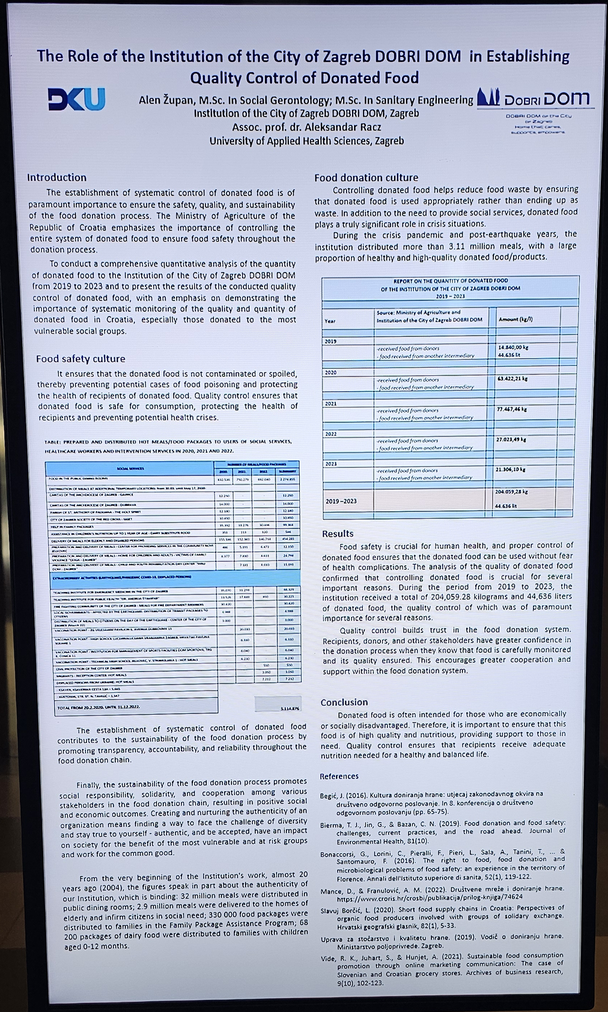
The Role of the Institution of the City of Zagreb DOBRI DOM in Establishing Quality Control of Donated Food
The establishment of systematic control of donated food is of paramount importance to ensure the safety, quality, and sustainability of the food donation process. The Ministry of Agriculture of the Republic of Croatia emphasizes the importance of controlling the entire system of donated food to ensure food safety throughout the donation process.
A comprehensive quantitative analysis of the amount of donated food was carried out in the DOBRI DOM Institution of the City of Zagreb from 2019 to 2023, in which we presented the results of quality control of donated food, with an emphasis on showing the importance of systematic monitoring of the quality and quantity of donated food in Croatia, especially that donated to the most vulnerable social groups.
Food safety culture
Food safety is crucial for human health, and proper control of donated food ensures that the donated food can be used without fear of health complications. The analysis of the quality of donated food confirmed that controlling donated food is crucial for several important reasons. During the period from 2019 to 2023, the institution received a total of 204,059.28 kilograms and 44,636 liters of donated food, the quality control of which was of paramount importance for several reasons.
First, it ensures that the donated food is not contaminated or spoiled, thereby preventing potential cases of food poisoning and protecting the health of recipients of donated food. Quality control ensures that donated food is safe for consumption, protecting the health of recipients and preventing potential health crises.
Second, controlling donated food helps reduce food waste by ensuring that donated food is used appropriately rather than ending up as waste. Third, the establishment of systematic control of donated food contributes to the sustainability of the food donation process by promoting transparency, accountability, and reliability throughout the food donation chain.
From the very beginning of the Institution's work, almost 20 years ago (2004), the figures speak in part about the authenticity of our Institution, which is binding: 32 million meals were distributed in public dining rooms; 2.9 million meals were delivered to the homes of elderly and infirm citizens in social need; 330 000 food packages were distributed to families in the Family Package Assistance Program; 68 200 packages of dairy food were distributed to families with children aged 0-12 months.
Food donation safety culture
Controlling donated food helps reduce food waste by ensuring that donated food is used appropriately rather than ending up as waste. In addition to the need to provide social services, donated food plays a truly significant role in crisis situations.
During the crisis pandemic and post-earthquake years, the institution distributed more than 3.11 million meals, with a large proportion of healthy and high-quality donated food/products.
Finally, the sustainability of the food donation process promotes social responsibility, solidarity, and cooperation among various stakeholders in the food donation chain, resulting in positive social and economic outcomes. Quality control builds trust in the food donation system. Recipients, donors, and other stakeholders have greater confidence in the donation process when they know that food is carefully monitored and its quality ensured. This encourages greater cooperation and support within the food donation system.
Donated food is often intended for those who are economically or socially disadvantaged. Therefore, it is important to ensure that this food is of high quality and nutritious, providing support to those in need. Quality control ensures that recipients receive adequate nutrition needed for a healthy and balanced life.
Image gallery