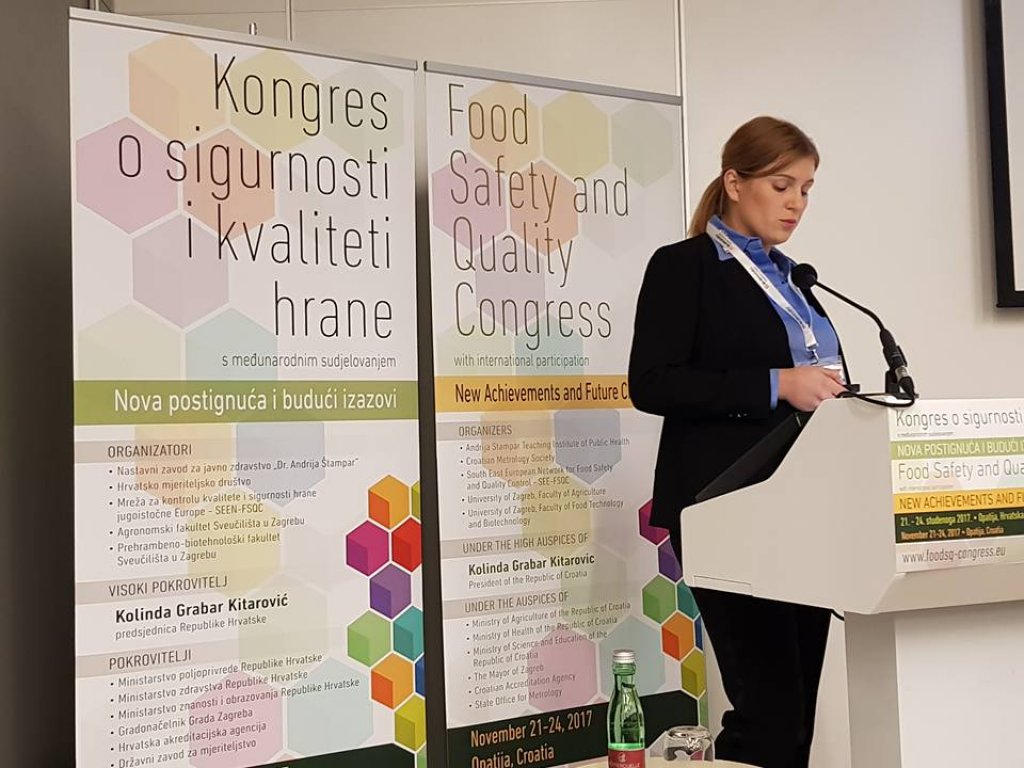
2nd International Congress on Food Safety and Quality - THE FOOD LIFE CYCLE, 13-16 November 2018, Opatija.
Encouraged by the great interest aroused by the First Croatian Congress on Food Safety and Quality with International Participation in November 2017
The Public Health Teaching Institute Andrija Štampar, organized an even larger and more educational Congress this year with the aim of exchanging experiences of Croatian and international experts and raising awareness on the topic of health and food safety.
The Second Congress program covered current topics in the field of food safety and quality, with an emphasis on the effects on human health and discussions on new technologies, crisis communication and risk management, organic food production and GMO, management systems, testing, certification and accreditation, the development and application of analytical methods, microbiological food safety, the safety of materials that come into contact with food and drinking water, geographical origin and food corruption, prevention of foodborne diseases and diseases, health tourism, trends in dietary supplementation, the Internet food sales and many other important and related topics.
Starting from the key assumption that food security is a shared responsibility of the state, manufacturers, distributors, the profession, and consumers themselves, top speakers and interlocutors spoke at expert and current topics in this field at this year's Congress. This year's edition of Congress is on the lookout for the First Congress, where it exchanged over 300 participants and 20 distinguished guest speakers from across the country and the world in four days, gathered even more lecturers and experts who encouraged new discussions and offered the latest knowledge of important topics in the field of food safety and quality. Director of the Institution Alen Župan, M.Sc. in Gerontology and Nataša Radulović, M.Sc. in Nutrition, took a very active part in the work of the Congress in front of the Institution, and they presented their work: INETRGRATED QUALITY MANAGEMENT SYSTEM IN A SOCIAL CARE INSTITUTION.
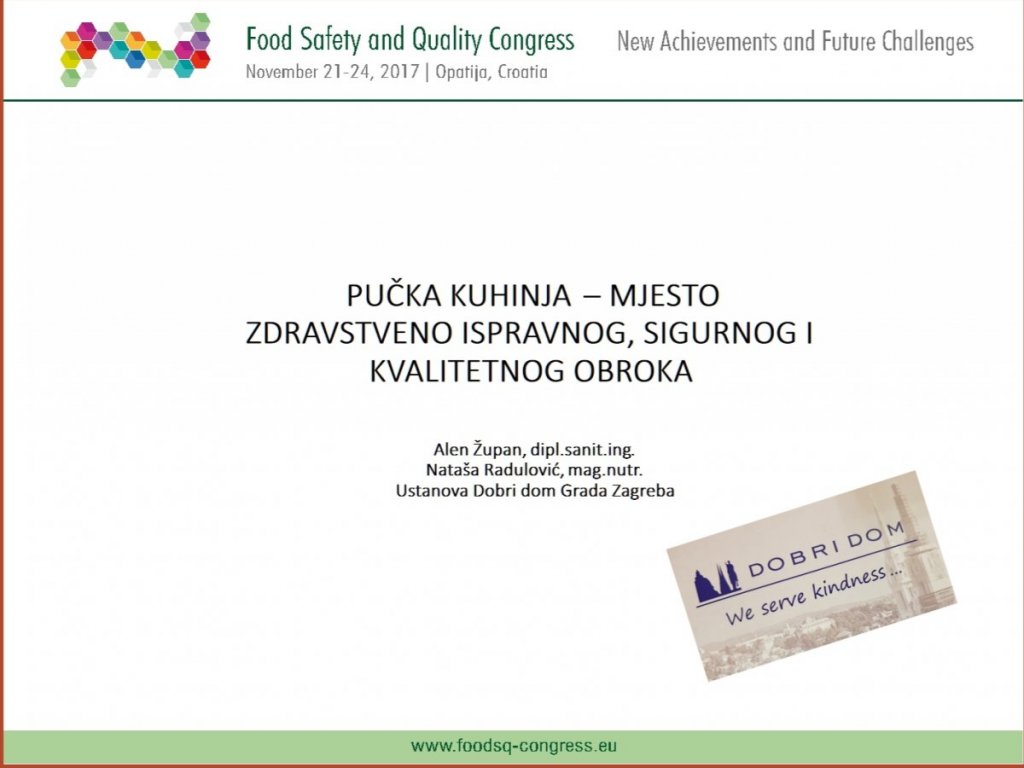
The institution also participated very actively in the work of the 1st Congress on Food Safety and Quality - NEW ACHIEVEMENTS AND FUTURE CHALLENGES, which took place in November 2017 in Opatija. In front of the Institution, the Director of the Institution, Alen Župan and Nataša Radulović, presented their work: PUBLIC DINING-ROOM - A PLACE OF A HEALTHY, SAFE AND QUALITY MEAL.
‘Dobri dom’ institution of the City of Zagreb is a unique institution in Europe providing food service for the citizens of the City of Zagreb in social need. Around 3,500 meals are prepared daily, or 1.2 million meals a year, and since the establishment of the Institution in 2004, 16 million meals. The purpose of the paper is to point out the provision of quality food service in the public kitchen, which results in a healthy, safe and quality meal and a satisfied customer. Also, the purpose of the paper is to create a comparative view of the quality of the complete service provided by the Institution through a comparison of the results of analyses by an authorized laboratory and the users' ratings of the quality of the service.
This paper presents the results of analysis by an authorized laboratory related to microbiological control of meals and items of general use, control of drinking water and determination of nutritional composition of meals. The obtained data were compared with the rating of the users on the quality of the complete service, which was obtained by personal survey on a sample of 399 examinees. The results of analytical reports on the control of meal, general use and drinking water show that all the controlled samples during the studied period are in compliance with the applicable legal regulations.
Since the establishment of the Institution in 2004, no cases of contamination of meals caused by inadequate handling during the preparation and distribution have been reported. The results of the analyses of the nutritional composition of the meals show that the meals, in terms of energy value, correspond to the recommended daily amounts of nutrients, that the proportions of the nutritional components are satisfactory and the diet balanced. The results of the surveys show lower ratings for quality and offer of meals (3.6) and portion size (3.7), while cleanliness, tidiness, space, staff kindness and commitment to work were rated higher (4.7).
The results of the analytical reports show that attention is paid to health and nutritional composition of prepared meals, as well as sanitary and hygienic conditions in the Institution. The results of the survey confirm the lower marks for the quality and the offer of the meals and the portion size, and therefore it can be concluded that there is room for improvement of the service.
Image gallery